Your firm may not be hard to find because it lacks expertise.
It may be hard to understand online because your website, Google Business Profile, reviews, directory listings, service pages, bios, blog content, social profiles, and structured data are sending mixed signals.
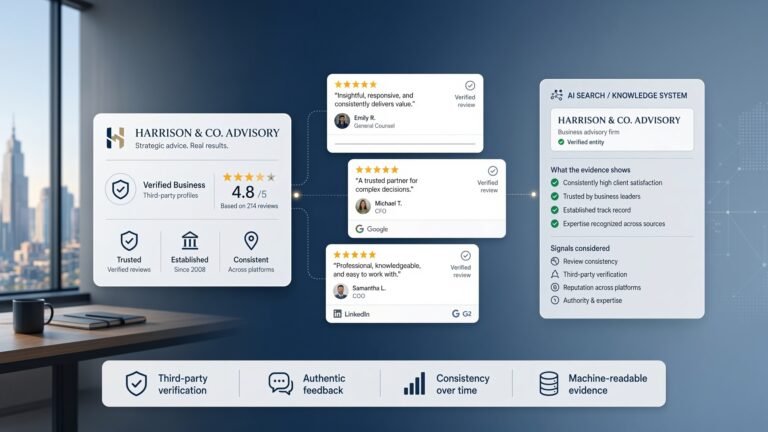
For high-trust professional service firms, visibility depends on more than simply being online. Potential clients, referral partners, search engines, and AI search experiences all rely on a broader set of signals to understand what your firm does, who you help, where you work, and why you are credible.
That makes signal alignment important.
AEO, or Answer Engine Optimization, is not about tricks or manipulating AI. It is about helping search and answer systems understand your firm accurately. SEO for professional services works in a similar direction: making your online presence clear, relevant, trustworthy, and easier to evaluate.
The goal is not to be everywhere.
The goal is to be specific, consistent, and credible in the places that matter.
Key Takeaways
- Your online presence sends mixed signals when important details about your firm are unclear, incomplete, outdated, or inconsistent across the web.
- Search engines and AI search experiences need context. They depend on patterns across content, profiles, reviews, structured data, business information, and other trust signals.
- Referral-based firms are still affected because referred prospects often search online before contacting a professional firm.
- Signal alignment can support SEO, AI search visibility, referral conversion, and credibility, but it cannot guarantee rankings, AI mentions, or leads.
- The goal is not louder marketing. The goal is clearer signals.
What Does “Mixed Signals” Mean in Online Visibility?
Mixed signals happen when your online presence does not tell one clear story.
For example, your website may describe your firm as a business law firm, but your Google Business Profile may emphasize general legal services. Your attorney bios may focus on litigation, while your service pages are thin or outdated. Directory listings may use old categories. Reviews may mention services that are not clearly explained anywhere on your website.
To a person, this can feel messy.
To search engines and AI search systems, it can reduce clarity.
Mixed signals can come from many places:
- Website homepage: Broad claims without clear service focus.
- Google Business Profile: Incomplete categories or outdated business details.
- Service pages: Thin content that does not explain who the service is for.
- Professional bios: Outdated credentials, roles, or practice areas.
- Reviews: Clients mention services the website barely explains.
- Directory listings: Old addresses, categories, or descriptions.
- Blog content: Old or irrelevant topics that no longer match the firm’s focus.
- Structured data: Missing or inconsistent business information.
- Social profiles: Inactive or unclear messaging.
The issue is rarely one small inconsistency.
The problem develops when several small inconsistencies create a confusing pattern.
For a professional firm, that matters because your online presence often begins building or weakening trust before a potential client ever contacts you.
Why Search Engines and AI Search Need Consistent Signals
Search engines and AI search experiences need consistent signals because they are trying to interpret what a business is, what it offers, where it operates, and when it may be relevant to a user’s question.
For professional service firms, this matters because your work is often nuanced.
An attorney may serve several practice areas.
A financial advisor may specialize in certain life stages or client types.
A mortgage professional may work with specific borrower situations.
An accountant may serve business owners, individuals, or niche industries.
An insurance professional may focus on personal lines, commercial coverage, or specialized policies.
If the firm’s website, business profile, service descriptions, reviews, and directory listings do not reinforce the same core message, the online identity becomes harder to interpret.
A firm may have strong offline authority, but if its digital presence does not clearly reflect that authority, the online picture may be weaker than the real-world reputation.
Structured data can also support clarity by helping organize information about a page, business, person, service, or article in a machine-readable way. But structured data is not a standalone solution. It works best when the content itself is already clear and the broader online presence supports the same story.
Clarity matters at every layer:
- Website content
- Business profiles
- Reviews
- Service pages
- Professional bios
- Directory listings
- Local signals
- Structured data
- Educational content
- Internal links
- Calls to action
When those pieces align, your firm becomes easier to understand.
When they conflict, your firm may become harder to trust, harder to categorize, and harder to choose.
Why a Good Website May Still Not Be Enough
A good website matters.
But a website does not carry the full weight of your online presence.
A potential client may first find your Google Business Profile. They may read reviews before visiting your website. They may compare your firm with competitors in directories. They may scan LinkedIn bios. They may ask an AI search tool for options, explanations, or comparisons. They may never follow the path you expect.
That means a professional firm’s visibility is an ecosystem, not a single asset.
Your website can be strong and still be undercut by weak surrounding signals.
If your site says one thing, your profiles say another, and your reviews point to services you do not clearly explain, the overall story becomes harder to trust.
This is especially important for high-trust professional services because people are not making casual decisions. They may be choosing someone to help with a legal matter, financial decision, mortgage question, insurance concern, tax issue, business problem, or sensitive life transition.
They are looking for confidence.
Mixed signals create hesitation.
Common Places Professional Firms Send Conflicting Signals
Professional firms often evolve faster than their online presence.
A firm may add a new service, narrow its focus, change partners, expand into another location, shift toward a more specialized client base, or stop offering something it once promoted. The website may be updated, but older profiles and content may remain unchanged.
Over time, this creates signal confusion.
Inconsistent Business Categories
Categories help search systems and users understand what type of business you operate.
If a mortgage professional, financial advisor, accountant, insurance agency, law firm, or consulting firm uses categories inconsistently across profiles, the firm may appear less specific than it should.
A broad category may not be wrong, but it may not be enough.
Specificity matters.
Unclear Service Descriptions
Service pages often use broad language such as “comprehensive solutions,” “personalized guidance,” or “trusted support.”
Those phrases may sound polished, but they may not clearly explain:
- What the firm does
- Who the service is for
- What problem the client is trying to solve
- When someone should reach out
- What makes the firm a good fit
Professional service visibility improves when the language is specific enough to be understood by both people and search systems.
Outdated Professional Bios
Bios are trust assets.
If attorney, advisor, accountant, consultant, producer, or team bios do not reflect current roles, credentials, specialties, locations, or client focus, they can weaken authority signals.
A strong bio does more than list experience. It helps explain why the person is relevant, credible, and connected to the firm’s current work.
Thin Service Pages
A service page with only a few sentences may not provide enough context.
Potential clients need to understand the problem, the service, the fit, and the next step.
Search and AI systems also need enough context to understand how that service relates to the firm’s overall expertise.
Thin service pages often create a gap between what the firm actually does and what the web can understand.
Weak Directory Listings
Professional directories, local listings, association profiles, and business databases can support credibility.
They can also create confusion when they contain outdated addresses, phone numbers, categories, descriptions, or team information.
A single outdated listing may not matter much.
But several outdated listings can create a pattern of inconsistency.
Mismatched Reviews
Reviews can be powerful trust signals, but they can also reveal gaps.
If clients repeatedly mention a service, strength, location, or client experience that is not clearly reflected on your website, that is a signal alignment issue.
For example, if reviews frequently mention “helping my family through probate,” but the law firm’s website barely explains probate services, the firm may be missing an opportunity to align real client language with its online positioning.
Irrelevant or Old Content
Old blog posts, outdated announcements, and content that no longer reflects the firm’s direction can make the business look less current.
This is especially important for high-trust fields where accuracy and confidence matter.
Not every old article needs to be removed. But older content should still support the firm’s present-day focus, or at least not contradict it.
Why This Matters Even for Referral-Based Firms
Referral-based firms are not protected from online confusion.
A referred prospect may already trust the person who recommended you, but they still often search for your firm before contacting you.
They may want to confirm your services, read reviews, check your location, review your team, compare your credibility, or understand whether you handle their specific need.
This is where online reputation and visibility intersect.
A strong referral can create interest.
A clear online presence can reinforce that interest.
A confusing online presence can create hesitation.
For high-trust professional services, hesitation matters.
A potential client may not call to ask clarifying questions. They may quietly compare options and choose the firm that feels easier to understand.
The issue is not that your firm lacks credibility.
The issue may be that your credibility is not clearly represented across the places people check.
How Mixed Signals Affect Trust, Authority, and Discoverability
Mixed signals can weaken three important parts of professional service visibility: trust, authority, and discoverability.
Trust
Trust is affected when information looks incomplete, outdated, or inconsistent.
If a potential client sees different service descriptions, old bios, mismatched contact details, or unclear profiles, they may question whether the firm is active, organized, and aligned with their needs.
Trust is not only created by credentials.
It is also created by consistency.
Authority
Authority is affected when your expertise is not clearly connected to the right topics.
A financial advisor may want to be known for retirement planning, but if the website, bios, articles, and profiles do not reinforce that focus, the authority signal is weaker.
A law firm may be excellent in probate, estate planning, or elder law, but if those services are not clearly connected across its website, profiles, reviews, and content, the online authority may look diluted.
Discoverability
Discoverability is affected when search engines and AI search systems do not have enough consistent context to understand when your firm is relevant.
AI search visibility depends heavily on clear entities, recognizable expertise, useful content, and consistent online references.
That does not mean any firm can guarantee AI search mentions or rankings.
It means the firm should make itself easier to understand, summarize, compare, and evaluate.
The Five Areas Professional Firms Should Review
Evoltra focuses on five visibility pillars: Presence, Trust, Authority, Capture, and Scale.
These pillars help professional firms think about online visibility without reducing it to one tactic.
1. Presence: Can the Right People Find the Firm Clearly?
Presence asks whether your firm appears clearly in the places that matter.
This includes:
- Search results
- Google Business Profile
- Service pages
- Relevant directories
- Review platforms
- Professional profiles
- Branded search results
The question is not, “Are we everywhere?”
The better question is:
“Can the right people find a clear version of us when they are researching?”
2. Trust: Does the Online Presence Feel Credible and Consistent?
Trust asks whether your reviews, bios, business information, website content, and profiles support confidence.
In professional services, trust is often built before the consultation or first call.
A trust signal does not need to be flashy.
It needs to be accurate, current, and aligned with the firm’s real-world reputation.
3. Authority: Is the Firm Known for the Right Topics?
Authority asks whether your firm is clearly connected to the services, topics, and expertise that matter most.
This includes:
- Service pages
- Educational content
- Bios
- Reviews
- Directory profiles
- Internal links
- External references
- Structured content
A firm can have authority offline and still fail to communicate it online.
4. Capture: Is There a Clear Next Step?
Capture asks whether a potential client knows what to do when they are ready or almost ready to reach out.
This includes:
- Contact paths
- Service page clarity
- Consultation language
- Phone visibility
- Forms
- Calls to action
- Downloadable resources
- Helpful next-step guidance
The goal is not pressure.
The goal is a clear next step.
5. Scale: Can the Firm Keep Visibility Consistent Over Time?
Scale asks whether the firm can maintain clarity as services, team members, locations, reviews, and content evolve.
Professional firms change.
Signal alignment has to be maintained over time.
Practical Examples by Professional Service Type
Attorneys
A law firm may list several practice areas on its website, but attorney bios, directory profiles, and reviews may point strongly to only one or two areas.
If those signals are not aligned, the firm may appear less focused than it actually is.
Mortgage Professionals
A mortgage professional may specialize in first-time buyers, move-up buyers, investors, self-employed borrowers, or specific loan scenarios, but online profiles may only say “mortgage lending.”
That broad positioning can make the professional harder to understand.
Accountants
An accounting firm may serve business owners, individuals, or specific industries.
If service pages do not clearly distinguish tax planning, bookkeeping, advisory, and compliance support, potential clients may not know whether the firm fits their needs.
Financial Advisors
A financial advisor may focus on retirement planning, wealth management, business owners, families navigating transitions, or high-net-worth clients.
If the firm’s content, reviews, and profiles do not reinforce that focus, authority can look diluted.
Insurance Professionals
An insurance agency may handle personal lines, commercial coverage, life insurance, or specialized policies.
If listings and website content are too general, the agency may not appear clearly relevant to the right client needs.
What Should Firms Review First?
Professional firms should first review whether their online presence tells one clear story.
This does not require revealing a full technical process. It starts with strategic awareness.
Online Signal Alignment Checklist
At a high level, firms should review:
- Are the firm’s core services clear across the website and profiles?
- Is business information consistent across major online platforms?
- Does the Google Business Profile accurately reflect the firm today?
- Do professional bios support current credibility and focus?
- Do reviews align with the services the firm wants to be known for?
- Do service pages clearly explain who the service is for and when someone should reach out?
- Are directory listings current and consistent?
- Does older content still support the firm’s current direction?
- Is there a clear next step for potential clients?
- Does the online presence reflect the quality of the firm’s real-world reputation?
This checklist is not a full audit process. It is a starting point for understanding whether signal confusion exists.
Before investing more in ads, SEO, content, or campaigns, professional firms should understand whether their current visibility foundation is clear enough to support that effort.
Disclaimer: Visibility Work Supports Clarity, Not Guarantees
Visibility work can improve clarity, consistency, discoverability, and trust.
It can help search engines, AI search experiences, referral partners, and potential clients better understand what a firm does and why it may be relevant.
It cannot guarantee rankings, AI recommendations, lead volume, placement in any AI tool, or immediate results.
The purpose of signal alignment is to make the firm easier to find, understand, and evaluate.
It is not a promise of specific search outcomes.
Final Thought: Signal Alignment Is a Trust Strategy
Your firm’s online presence may send mixed signals even if your firm is experienced, credible, and well-regarded offline.
That gap matters because potential clients, referral partners, search engines, and AI search systems evaluate patterns across more than one source.
AEO for professional firms is not about chasing AI trends.
SEO for professional services is not only about keywords.
Strong visibility starts with making your firm clear, consistent, specific, and credible across the places that matter.
For Evoltra, the goal is simple: help high-trust professional firms become easier to find, trust, and choose across Google, AI search, reviews, website clarity, and online authority.
The first step is not always to do more marketing.
The first step is to understand what your current online presence is already communicating.
FAQs About Mixed Signals in Google and AI Search
What does it mean when a firm’s online presence sends mixed signals?
A firm sends mixed signals when its website, Google Business Profile, reviews, service pages, bios, directory listings, and online content do not communicate the same clear story. This can make the firm harder for potential clients, search engines, and AI search systems to understand.
Why does AI search visibility matter for professional firms?
AI search visibility matters because many search experiences now summarize, compare, and organize information for users. Professional firms need clear and consistent online signals so their services, expertise, location, and credibility are easier to understand.
Is AEO the same as SEO?
AEO, or Answer Engine Optimization, focuses on making information easier for answer systems and AI search experiences to understand. SEO, or Search Engine Optimization, focuses on improving visibility in search engines. For professional firms, both depend on clarity, useful content, trust signals, and consistent information.
Can mixed online signals hurt referral conversion?
Yes. A referred prospect may still search for the firm before reaching out. If the online presence feels outdated, incomplete, or inconsistent, the prospect may hesitate, compare other options, or choose a firm that feels clearer.
Does structured data help search engines understand a professional firm?
Structured data can help organize information about a page, business, service, person, or article in a machine-readable way. It is not a standalone solution, but it can support clarity when the website content and broader online presence are already aligned.
Should a firm fix visibility issues before spending more on ads or content?
In many cases, yes. More marketing can bring more attention, but it works better when the firm’s online foundation is clear. If the business profile, reviews, service pages, and website messaging are confusing, new traffic may not convert as well.
Can Evoltra guarantee AI search mentions or rankings?
No. Ethical visibility work cannot guarantee rankings, AI recommendations, lead volume, or placement in AI tools. Evoltra’s work is focused on improving clarity, consistency, trust signals, and discoverability.