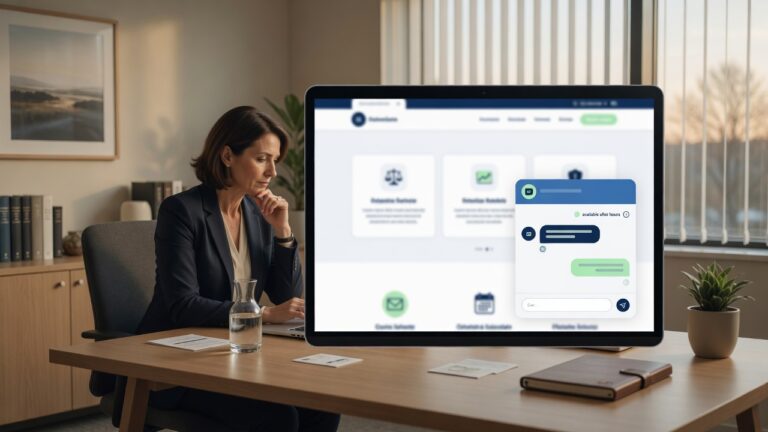
Professional firms do not lose inquiries only because they lack demand. They often lose inquiries because the first contact happens at the wrong time, through the wrong channel, or while the team is already busy helping someone else.
A prospect may call during a client meeting. Another may submit a form after business hours. Someone else may open a website chat on a Sunday night, compare several firms, and move on if the next step feels unclear.
That is where an AI intake system fits.
An AI intake system is not one tool. It is a connected capture layer that helps a professional firm answer, capture, and route new inquiries across phone, website, and text.
For attorneys, CPAs, financial advisors, mortgage professionals, insurance agencies, and other high-trust firms, the goal is not to replace professional judgment. The goal is to make sure a serious inquiry does not disappear before the firm has a chance to respond.
The Core Answer: What Is an AI Intake System?
An AI intake system is the set of tools a professional firm uses to answer, capture, and route new inquiries the moment they arrive, across phone, website, and text. It typically combines an AI voice receptionist for calls, a website chatbot for visitors, and automated SMS follow-up for form submissions, connected to the firm’s calendar and CRM.
It does not give professional advice and it does not replace the firm’s judgment. It makes sure the first contact is never lost while the team is with clients or the office is closed.
A complete intake system usually supports three common entry points:
| Prospect Entry Point | What the Firm Needs to Capture | How an Intake System Helps |
| Phone call | Name, reason for calling, contact details, urgency, next step | Answers or routes calls when staff are unavailable |
| Website visit | Basic questions, service interest, contact information | Guides visitors and captures inquiries through chat |
| Form submission | Submitted details, follow-up permission, next action | Sends structured follow-up and keeps the inquiry moving |
The key idea is simple: prospects choose the door that is easiest for them. A firm that only covers one door may still lose inquiries through the others.
Key Takeaways
- An AI intake system helps professional firms answer, capture, and route inquiries across phone, website chat, and text.
- It is a system view, not a single-channel tool.
- The three doors are calls, website visits, and form submissions, each covered by a matched tool: an AI voice receptionist, a website chatbot, and SMS follow-up.
- The pieces work best when connected to the firm’s calendar and CRM, so no handoff is dropped between first contact and follow-up.
- An intake system should never give legal, financial, tax, mortgage, insurance, or professional advice.
- An intake system does not guarantee new clients, and it never replaces professional judgment. It protects the inquiries a firm has already earned so the first contact is not the last.
Why the First Response Often Decides the Outcome
When someone reaches out to a professional firm, their interest is usually active in that moment. They may have been referred by someone they trust, found the firm on Google, read reviews, or compared several firms before reaching out. By the time they call, chat, or submit a form, they are not only browsing. They are raising their hand.
The problem is that professional firms are often unavailable at the exact moment that hand goes up. Attorneys may be in consultations. CPAs may be deep in client work. Advisors, mortgage professionals, and agency owners may be in meetings, on calls, or handling renewals and closings.
None of that means the firm is doing something wrong. It means the firm needs a better way to protect the first contact.
Interest does not last indefinitely; it can fade in hours or in days. A prospect who reaches out to one firm may also contact another, and if one firm responds clearly while the other stays silent, the first meaningful response can shape the next step.
This is why intake matters. Visibility helps people find the firm. Intake helps the firm respond when they do.
The Three Doors: Calls, Website Visits, and Form Submissions
Most professional firms think about intake as a phone problem, but that is only part of the picture. Today, prospects contact firms through whichever path feels easiest in the moment. Some call, some open chat, some fill out a form, and some do more than one.
A connected intake system recognizes three doors.
Door 1: Phone Calls
Phone calls are still one of the most direct forms of intent. When someone calls a professional firm, they usually want a clear next step. But calls are also easy to miss: the team may be with another client, in court, in a consultation, at lunch, on another call, or the office may simply be closed for the evening or the weekend.
An AI voice receptionist helps answer calls in those moments. It can collect the caller’s name, contact information, reason for calling, and preferred next step, then route the inquiry according to the firm’s process. Its job is not to evaluate the matter. Its job is to make sure the call does not vanish. For a law firm, that may mean capturing a potential estate planning inquiry; for a CPA, it may mean noting whether someone is asking about tax planning or business accounting before the team follows up.
This is not the same as replacing a receptionist. It is a way to cover the moments when the team cannot answer. For firms that miss calls after hours or during busy periods, the AI Voice Receptionist service supports this part of the intake layer.
Door 2: Website Visits
A website visitor may not be ready to call. They may be reading service pages, checking whether the firm handles their situation, or trying to decide whether the firm feels like a fit.
A website chatbot supports that moment. It can answer practical questions, point visitors toward the right service page, and capture contact information when someone is ready to take the next step. This is especially useful for firms with multiple services, where a visitor may not know which page applies to their situation. The chatbot should stay within safe boundaries: it can explain where to go, what to submit, or how to request contact, and it should never give legal, financial, tax, mortgage, insurance, or professional advice.
For a deeper explanation of what a website chatbot actually does, Evoltra’s dedicated chatbot article explains that channel in detail. For firms that want structured visitor capture on the website, the Website Chatbot service supports this part of the system.
Door 3: Form Submissions
Forms are useful, but they are passive. A form waits for the visitor to submit information, and then the visitor waits for the firm to respond. If someone submits a form after hours, on a weekend, or during a busy workday, the firm may not reply until much later. By then, the prospect may have contacted another firm or lost momentum.
SMS lead automation helps keep the inquiry moving after capture. A structured text can confirm that the inquiry was received, help gather basic next-step information, or guide the person toward scheduling, depending on the firm’s process. The tone should stay professional and respectful: SMS follow-up should acknowledge the inquiry and create a clearer next step, never pressure anyone or make promises.
For firms that need better follow-up after capture, the SMS Lead Automation service supports this part of the intake system.
The response-time side of that layer, what a prompt and useful first reply protects and what a slow one gives away, has its own article.
How the Pieces Connect: Calendars, CRMs, and No Dropped Handoffs
The strongest intake systems are not just a collection of separate tools. They are connected.
A professional firm may have a phone answering layer, website chat, contact forms, calendar scheduling, CRM records, and SMS follow-up. If those pieces do not work together, inquiries can still fall through the cracks. At a high level, a connected intake system helps:
- capture the inquiry and record basic information,
- route it to the right place and notify the team,
- connect with a calendar when scheduling is appropriate,
- support follow-up without duplicated manual work,
- create a clearer first experience for the prospect.
This is where the system view matters. A chatbot alone may help website visitors. A voice receptionist alone may help missed calls. SMS alone may help follow-up. But if those pieces are disconnected, the firm may still have gaps. The point of an intake system is to connect the first contact to the next step with less friction.
What an Intake System Should Never Do
An intake system should have firm boundaries. This is especially important for professional services, where the inquiry may involve sensitive, regulated, personal, or high-consequence decisions.
It Should Not Give Professional Advice
An AI intake system should not provide legal, financial, tax, mortgage, insurance, or professional advice. It can answer practical questions about the firm, its services, contact process, location, or next steps. It can collect details, route inquiries, and help someone request a consultation. But it should not interpret a legal matter, recommend a financial decision, provide tax guidance, assess mortgage eligibility, or advise on insurance coverage. Those responsibilities belong to qualified professionals.
It Should Not Diagnose the Prospect’s Situation
A prospect may describe a sensitive or complex issue. The intake system should not diagnose the problem or decide what the person needs: which legal strategy to pursue, what tax position to take, how to structure a financial decision, whether they qualify for a loan, or which coverage is sufficient. It should collect basic context and route the inquiry to the firm. That is enough.
It Should Not Replace Human Judgment
Intake involves more than collecting information. The firm’s team may need to evaluate fit, urgency, conflicts, capacity, risk, and next steps. Automation can support that process, but it should not replace the judgment behind it. This distinction protects the firm and the prospect.
It Should Not Pressure Prospects
A good intake system should feel helpful, not pushy. It should not pressure someone into booking, exaggerate urgency, or make a visitor feel trapped in an automated sequence. Professional firms build trust through clarity, and the intake experience should reflect that.
It Should Not Promise Outcomes
An intake system should not promise that the firm will accept the inquiry, that the prospect will become a client, that a matter will be resolved, that financing will be approved, or that automation alone will improve business results.
An intake system does not guarantee new clients, and it never replaces professional judgment. It protects the inquiries a firm has already earned so the first contact is not the last.
What Implementation Actually Involves
This article is not a setup guide. The “how” belongs inside Evoltra’s service process, because a professional firm’s intake system should be designed around the firm’s real services, staffing, tone, risk boundaries, and follow-up needs.
At a high level, implementation starts with understanding the firm’s inquiry paths: Where do inquiries currently arrive? Which channels are being missed? What happens after someone calls, chats, or submits a form? Which inquiries are a good fit, and which should be routed differently? What information does the team need before follow-up, and where should it go after capture?
The details matter because an intake system should not feel generic. An estate planning firm should not sound like a mortgage office, a CPA firm should not route inquiries like an insurance agency, and a financial advisor’s first contact rarely looks like a consultant’s. The system should reflect the firm. That means implementation is less about installing a tool and more about designing a clearer first-contact experience.
Where the Authority Score Fits
An intake system works best when the broader online presence is already creating trust. If prospects do not understand the firm, do not trust the website, or cannot find clear service information, they may never reach the intake system at all. That is why intake belongs inside a larger visibility and trust picture.
Evoltra’s Authority Score assessment helps a professional firm see whether its online presence is clear, credible, and consistent enough to support the inquiries it wants to capture. It is not a replacement for an intake system; it helps identify whether the foundation underneath one is solid.
The Bottom Line: Intake Protects the Interest You Already Earned
A professional firm works hard to earn attention. It builds a reputation, earns referrals, invests in a website, publishes service pages, and serves clients well. But when a prospect finally reaches out, that interest is perishable. If the call is missed, the chat goes unanswered, or the form sits too long, the opportunity can fade.
An AI intake system helps protect that moment. It connects the three main doors, calls, website visits, and form submissions, and supports faster first contact, clearer routing, and better follow-up across the channels prospects already use.
It does not replace the firm. It does not give professional advice. It does not guarantee new clients. It simply helps make sure the first contact is captured, organized, and handed off before the moment disappears.
For high-trust professional firms, that can be the difference between a missed inquiry and a qualified conversation.
New to the library? Start here to see how intake fits into Evoltra’s broader approach to visibility, trust, and authority.
Frequently Asked Questions
Will an AI intake system sound robotic to my clients?
Modern conversational systems can be configured around the firm’s services, tone, and intake needs. They should also make it clear when a caller or visitor can reach a person. The goal is a helpful first step, not a cold or robotic experience.
Does AI intake replace my receptionist or staff?
No. AI intake does not replace receptionists, intake staff, or professional judgment. It covers moments when staff cannot respond, such as after hours, during meetings, during busy call periods, or when multiple inquiries arrive at once.
Can these systems give legal, financial, or tax answers?
No. AI intake systems should not give legal, financial, tax, mortgage, insurance, or professional advice. They should answer practical questions, capture details, and route the inquiry to the firm.
Do I need all three components at once?
No. Most firms start with the channel where they lose the most inquiries. Some start with calls, others with website chat, and others need better follow-up after forms. The right starting point depends on where the firm’s intake gaps are.
Is a website chatbot the same as an AI intake system?
No. A website chatbot is one part of an AI intake system. A full intake system may also include an AI voice receptionist, SMS lead automation, calendar connections, CRM routing, and internal follow-up processes.