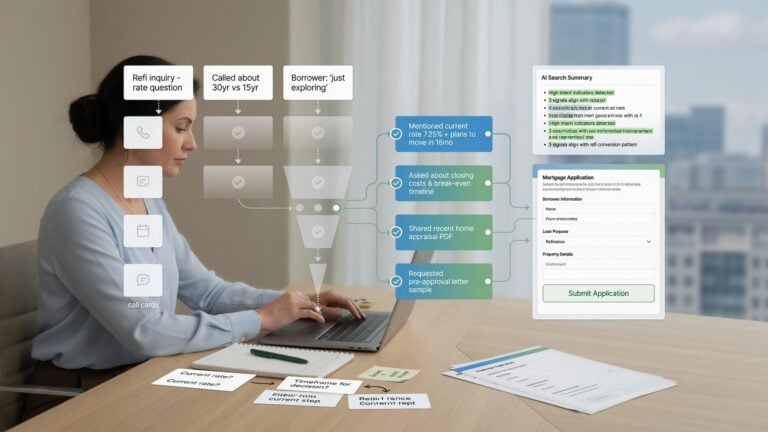
High-intent refinance conversations do not begin when a borrower calls, fills out a form, or requests a quote. They begin earlier, during private research, when homeowners compare rates, equity options, cash-out scenarios, closing costs, and timing. In 2026, more of that research happens through Google and AI search before a lender ever sees the borrower.
For many mortgage lenders, the biggest frustration in today’s refinance market is not only the number of leads. It is the quality of conversations.
Intake teams spend time on calls that do not move forward. Borrowers sound curious but not ready. Follow-ups stretch out. Fallout remains high. Marketing activity may look busy, but the pipeline feels inconsistent.
The issue is not always the intake team.
Often, the issue is visibility timing.
If a lender only becomes visible after the borrower has already researched, compared, and formed opinions, the first call may begin too late in the decision process.
This article is Part 5 of Evoltra’s Refinance Demand Series: Why Refinance Leads Are Drying Up, The End of Bought Mortgage Leads, Why Refinance Conversations Do Not Convert Like They Used To, Why Refinance Conversations Stall Before the Application: Interest vs Intent, and this article.
The Main Answer: Why Do High-Intent Refinance Conversations Start Before the First Call?
High-intent refinance conversations start before the first call because borrowers form expectations, questions, trust, and timing during private research. By the time a homeowner contacts a lender, they may already understand their refinance scenario, compare options, and decide which providers feel credible.
That private research phase shapes the quality of the conversation.
A borrower who has already seen clear, relevant information may enter the call with better questions and more realistic expectations. A borrower who has not found helpful context may call too early, call the wrong lender, or fail to move forward after the first conversation.
For refinance teams, the opportunity is not simply to generate more calls. The opportunity is to become visible earlier, when borrower intent is forming.
Key Takeaways
- Refinance conversation quality is shaped before the first call.
- Borrowers often research privately before they contact a lender.
- AI search can answer refinance questions directly, which changes how borrowers evaluate options.
- The Mortgage Bankers Association forecast refinance originations to increase 9.2% to $737 billion in 2026, which shows refinance demand still exists in a selective market.
- The CFPB says comparing Loan Estimates from multiple lenders can help borrowers save money and choose a mortgage that fits their needs.
- Pew Research Center found that users who encountered a Google AI summary clicked traditional search results less often than users who did not see an AI summary.
- Evoltra Solutions helps mortgage businesses and high-trust professional firms become easier to find, trust, and choose across Google, AI search, reviews, website clarity, business profiles, directories, and authority signals.
The Silent Phase of Refinance Decision-Making
Homeowners rarely wake up and immediately call a lender.
They usually begin with questions. They compare scenarios. They test assumptions. They try to understand whether refinancing makes sense before they share their information.
This silent phase may include questions such as:
- Should I refinance now or wait?
- Does refinancing make sense if my current rate is lower?
- Is a cash-out refinance a good option?
- Should I choose a HELOC instead?
- How much equity do I need?
- What are refinance closing costs?
- How long does it take to break even?
- Will refinancing lower my payment enough to matter?
- Which lender should I trust?
These questions do not always create visible leads. But they do create intent.
A borrower may spend days or weeks gathering information before contacting anyone. During that time, they are shaping expectations about what refinancing means, what options are realistic, and which lenders feel credible.
That is why the first call is rarely the true beginning.
It is usually the first visible sign of a much longer decision process.
Why So Many Refinance Intake Calls Feel Unproductive
Refinance intake calls often feel unproductive when the lender enters the borrower journey too late or too early.
Some borrowers call before they understand the basic decision. They may want education, reassurance, or a quick answer, but they are not ready for a serious loan conversation.
Other borrowers call after they have already formed assumptions from comparison sites, calculators, AI summaries, ads, or content from competitors. In that case, the lender has to correct, reframe, or rebuild trust during the first conversation.
Both situations create friction.
The intake team may hear:
- “I’m just checking.”
- “I wanted to see what rates are.”
- “I’m not sure if this makes sense.”
- “Another lender told me something different.”
- “I saw online that I should wait.”
- “I thought closing costs would be lower.”
- “I’m not ready yet.”
These are not necessarily bad borrowers. They may simply be at the wrong stage of readiness.
The problem is not always the call script, the loan officer, or the follow-up cadence. Often, it is the lack of earlier visibility during the borrower’s research phase.
Visibility Shapes Conversation Quality
Borrowers arrive differently when they have already encountered clear, relevant information from a lender.
They may understand the tradeoffs better. They may know why they are calling. They may have a more realistic view of costs, rates, timing, and options. They may already feel some trust because the lender appeared during the research process.
That changes the first conversation.
Instead of beginning with broad education, the call can begin with alignment.
The borrower is not simply asking, “What is your rate?”
They may be asking:
- “Here is my situation. Does refinancing make sense?”
- “I’m comparing a cash-out refinance and a HELOC.”
- “I want to understand my break-even point.”
- “I’m trying to lower my monthly payment without making a bad long-term decision.”
- “I saw your explanation and wanted to ask about my numbers.”
Those are stronger conversations.
They are not guaranteed to convert, but they usually begin with more context.
Why AI Search Is Changing the First Call
AI search is changing the first call because it changes what borrowers know before they make contact.
Google’s Search Central guidance explains that AI features such as AI Overviews and AI Mode are part of Google Search from a site owner perspective. These features can present AI-generated responses and links inside the search experience.
That matters because refinance questions are often complex and scenario-based.
A homeowner may ask an AI-powered search experience to compare refinance options, explain closing costs, calculate tradeoffs, or clarify when refinancing makes sense. The borrower may receive a direct explanation before visiting a lender’s website.
Pew Research Center found that Google users who encountered an AI summary clicked a traditional search result link in 8% of visits, compared with 15% of visits when no AI summary appeared.
For lenders, the practical point is clear: some borrower education now happens without a click.
That does not mean websites are irrelevant. It means websites, content, business profiles, reviews, and authority signals need to support recognition earlier in the journey.
Intent Timing Matters More Than Lead Volume
Many refinance teams try to fix weak conversation quality with more lead volume.
More campaigns. More outreach. More purchased leads. More follow-ups.
That may increase activity, but it does not always improve outcomes.
Lead volume cannot fix poor timing.
If a borrower is not ready, more outreach may feel like pressure. If a borrower already trusts another source, a late-stage call may feel like interruption. If a borrower does not understand the financial tradeoffs, the call may become educational but not actionable.
Poor timing can lead to:
- Lower contact rates
- Longer follow-up cycles
- More unqualified conversations
- Higher fallout
- More pricing objections
- More borrower confusion
- Lower intake efficiency
- Higher cost per funded loan
- More strain on loan officers
High-intent visibility solves a different problem.
It helps align lender presence with borrower readiness.
The goal is not simply to create more calls. The goal is to create better-fit conversations with borrowers who already understand why a lender may be relevant.
The Top of the Funnel Has Moved Upstream
For years, the top of the refinance funnel was often treated as a landing page, ad, rate quote, or form fill.
That view is now too narrow.
The top of the funnel increasingly begins when a borrower asks a question privately.
That question may happen inside Google, an AI search experience, a comparison tool, a calculator, a video platform, a review site, or a lender’s educational content.
A 2026 academic study of Google AI Overviews found that AI Overviews appeared in 13.7% of trending queries overall and 64.7% of question-form queries during the study period. It also found that nearly 30% of AI Overview-cited domains did not appear in the co-displayed first-page results.
That finding matters because refinance research is highly question-driven.
The borrower may not search only “refinance lender near me.” They may ask detailed questions about whether refinancing is worth it, how equity works, or whether a cash-out refinance is a good idea.
If a lender is absent from those early answer environments, it may never become part of the borrower’s shortlist.
Recognition Matters Before Contact
AI search and answer-style search experiences make recognition more valuable.
Recognition does not mean the borrower has memorized the lender’s brand. It means the borrower has encountered the lender’s expertise, content, name, reviews, or authority signals during the research phase.
That early exposure can influence trust.
When borrowers see a lender connected to clear, useful refinance information, they may feel more comfortable engaging later. When they see no clear presence, they may choose a lender that appeared more relevant during their research.
A 2026 empirical study comparing Google Search, Gemini, and Google AI Overviews found that generative search systems retrieve and present sources differently from traditional search results, with low overlap among retrieved sources.
That means traditional ranking visibility and AI search visibility are related, but not identical.
Mortgage lenders cannot assume that showing up in one environment means they are clearly recognized in another.
What High-Intent Refinance Visibility Looks Like
High-intent refinance visibility means a lender is easier to find, understand, and trust when borrowers are actively trying to evaluate their options.
It is not about chasing every keyword. It is not about publishing endless generic refinance content. It is not about promising rankings, AI mentions, or lead volume.
It is about aligning the lender’s online presence with the borrower’s decision process.
That can include visibility across:
- Refinance service pages
- Google search
- AI search
- Google Business Profile
- Reviews
- Educational refinance content
- Branded search results
- Local or regional search signals
- Business profiles
- Directory listings
- Authority mentions
- Borrower scenario content
The important question is whether the lender appears credible when borrowers are still deciding whether to act.
Why Borrowers Need Confidence Before They Call
Refinancing can affect monthly payment, total interest, loan term, equity, cash flow, and closing costs. Borrowers may want to feel informed before sharing personal financial information.
The CFPB encourages borrowers to request Loan Estimates from multiple lenders, noting that comparing offers can help borrowers save money and choose a mortgage that meets their needs.
That means borrowers are not only looking for a lender. They are evaluating whether a lender deserves a place in the comparison set.
Before calling, they may look for:
- Clear explanations
- Trustworthy reviews
- Helpful refinance resources
- Local or market relevance
- Transparent next steps
- A credible loan officer or team
- Consistent business information
- Proof that the lender understands their scenario
If those signals are weak, borrowers may keep researching or choose another provider.
That risk does not end at first contact, which is why protecting inquiry momentum with a prompt, useful response matters once a borrower does reach out.
Why Intake Teams Feel the Cost of Weak Upstream Visibility
When upstream visibility is weak, intake teams often absorb the consequences.
They may spend more time explaining basics. They may field more low-intent calls. They may handle more borrowers who are not financially ready, not clear on goals, or not sure why they contacted the lender.
That creates operational strain.
The team may be working hard, but the conversations are not aligned.
This can affect:
- Productivity
- Follow-up quality
- Forecasting
- Morale
- Conversion rates
- Pipeline clarity
- Cost per funded loan
- Borrower experience
A visibility issue can look like a sales issue. But if borrowers are arriving without enough context or trust, the problem started before the call.
Why This Is Not Just a Refinance SEO Problem
This is not only a traditional SEO problem.
SEO still matters. Search visibility still matters. Website structure still matters. But high-intent refinance conversations depend on more than keyword rankings.
They depend on whether the lender’s online presence clearly supports borrower confidence across the full research journey.
That includes:
- Website clarity
- AI search visibility
- Google Business Profile clarity
- Review quality
- Content relevance
- Local trust signals
- Business profile consistency
- Branded search results
- Authority signals
- Service page clarity
- Helpful explanations
- Clear next steps
A lender can have traffic and still have weak conversation quality.
A lender can receive leads and still lack borrower readiness.
The deeper issue is whether the lender is visible at the right moment with the right context.
What Lenders Should Review at a High Level
This is not a detailed DIY checklist or an implementation roadmap. But refinance teams should understand the areas that shape conversation quality before the first call.
At a high level, lenders should review whether their online presence supports:
- Borrower readiness
- Refinance scenario clarity
- AI search visibility
- Google search visibility
- Website service clarity
- Review trust signals
- Google Business Profile accuracy
- Local or regional relevance
- Educational content quality
- Business profile consistency
- Branded search confidence
- Clear next steps for informed borrowers
The goal is not to give away a full strategy.
The goal is to identify whether the lender’s visibility appears early enough to shape better conversations.
How Evoltra Solutions Helps
Evoltra Solutions helps mortgage businesses and high-trust professional firms become easier to find, trust, and choose across Google, AI search, reviews, website clarity, business profiles, directories, and online authority signals.
For refinance-focused lenders, Evoltra looks at how borrowers may encounter the business before the first call. That includes Google visibility, AI search visibility, refinance content, reviews, service pages, business profiles, and trust signals.
Evoltra does not promise rankings, AI recommendations, lead volume, funded loans, or immediate results. Those outcomes cannot be guaranteed.
The focus is clarity, visibility, and trust.
The goal is to help lenders understand whether their online presence supports high-intent conversations, or whether borrowers are reaching out too late, too early, or without enough context.
Final Thoughts: Better Refinance Conversations Start Earlier
The most valuable refinance conversations do not start with a cold intake call.
They start when a borrower is still researching, comparing, and deciding whether refinancing makes sense. They start when the borrower encounters a clear answer, a credible lender, a relevant explanation, or a trust signal that makes the next step feel easier.
In 2026, AI search and private research are reshaping how borrowers prepare before contact.
That means refinance teams cannot judge demand only by visible leads.
High-intent conversations begin upstream. They begin before the form fill. They begin before the first call.
The lenders that adapt will not simply chase more activity. They will work to be recognized earlier, so the conversations that do happen are more informed, more aligned, and more likely to move forward.
Previous in the series: Why Refinance Conversations Stall Before the Application: Interest vs Intent
FAQs
Why do high-intent refinance conversations start before the first call?
High-intent refinance conversations start before the first call because borrowers form expectations during private research. They compare rates, equity options, cash-out scenarios, costs, and lender credibility before they contact anyone.
Why do refinance intake calls feel less productive?
Refinance intake calls may feel less productive when borrowers contact lenders before they are ready or after they have already formed assumptions elsewhere. Weak upstream visibility can leave intake teams handling education, qualification, and trust-building during the first call.
How does AI search affect refinance conversations?
AI search affects refinance conversations by answering borrower questions before they visit a lender’s website or submit a form. Borrowers may use AI search to understand refinancing, compare options, and decide which lenders feel credible.
Does AI search reduce website clicks?
It can. Pew Research Center found that Google users who encountered an AI summary clicked traditional search results less often than users who did not encounter one. That means some borrower education may happen inside the search experience.
What is high-intent refinance visibility?
High-intent refinance visibility means being easy to find, understand, and trust when borrowers are actively researching whether refinancing makes sense. It focuses on timing, context, relevance, and trust rather than only lead volume.
Why does lead volume not always improve refinance conversions?
Lead volume does not always improve conversions because more leads can still be low-intent, poorly timed, or unprepared. Refinance teams need better-fit conversations, not just more names or calls.
Should mortgage lenders focus on AI search visibility?
Mortgage lenders should understand AI search visibility because AI search is becoming part of how borrowers research refinance questions. AI visibility does not guarantee leads or rankings, but it can support earlier recognition and trust.
Can better visibility guarantee better refinance conversations?
No. Better visibility cannot guarantee better conversations, rankings, AI mentions, leads, or funded loans. It can help lenders identify whether their online presence supports borrower readiness before the first call.