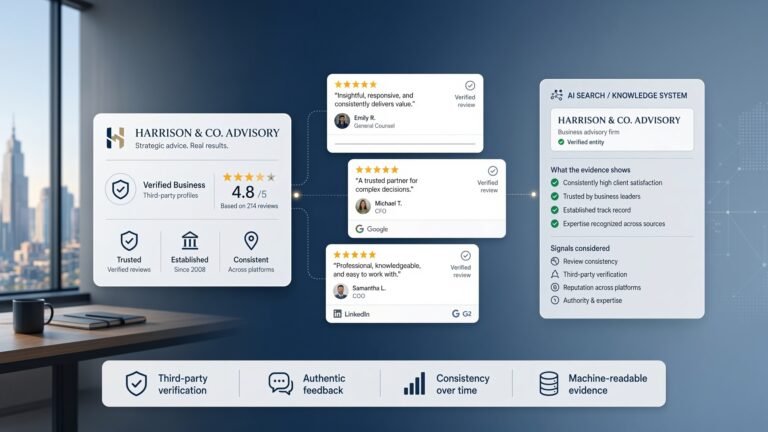
Professional firms often lose visibility not because they lack expertise, but because their online presence tells different stories in different places. A firm’s website may describe one focus, its Google Business Profile may suggest another, directory listings may be incomplete, bios may be outdated, and reviews may not clearly reflect the services the firm wants to be known for.
For trust-based professional service firms, this matters because people and search systems both rely on patterns. Google, AI search tools, and potential clients need consistent signals to understand who the firm serves, what it does, where it operates, and why it should be trusted.
This is not only a marketing issue. It is a clarity issue.
Attorneys, mortgage brokers, CPAs, financial advisors, insurance professionals, consultants, and other professional firms are not impulse-purchase businesses. Prospects usually want reassurance before they reach out. They may compare reviews, scan service pages, check bios, search the business name, review profiles, and look for signs that the firm handles their specific need.
If those signals are fragmented, the firm may become harder to find, harder to understand, and harder to choose.
The Main Answer: Why Do Professional Firms Lose Visibility When Profiles Are Inconsistent?
Professional firms lose visibility when their online profiles tell different stories because Google, AI search tools, and potential clients rely on consistent signals to understand who the firm serves, what it does, where it operates, and why it should be trusted.
Google says local results are mainly based on relevance, distance, and prominence. Relevance depends on how well a Business Profile matches what someone is searching for, while prominence is influenced by information Google has about a business across the web.
That means inconsistency can create friction. If a firm’s website, Google Business Profile, reviews, directory listings, bios, service pages, and online content do not support the same message, search systems and prospects may receive an unclear picture.
AI search adds another layer. Google’s guidance indicates that generative AI features in Search are connected to its core Search systems and may use content from Google’s indexed web results when creating an answer.
The practical takeaway is simple: professional firms need their online presence to be clear, consistent, and specific across the places where they appear.
Key Takeaways
- Professional firms do not always have a bad online presence. Many have a fragmented online presence.
- Consistency matters because trust-based buyers look for clarity before contacting a firm.
- Google uses signals such as business information, relevance, prominence, reviews, service content, and broader web references to understand local businesses.
- AI search systems depend on clear patterns, credible sources, and repeated context when summarizing or interpreting businesses.
- Visibility is not only about rankings. It is about becoming easier to find, understand, trust, and choose.
- Evoltra helps high-trust professional firms align their online presence across Google, AI search, reviews, website clarity, business profiles, directories, and authority signals.
Why Consistency Matters More for Trust-Based Firms
Consistency matters more for trust-based firms because clients are making higher-consideration decisions. A person choosing an attorney, mortgage broker, CPA, financial advisor, insurance professional, or consultant is usually not making a quick purchase.
They are looking for confidence.
A prospect may want to know:
- Does this firm handle my specific issue?
- Does the firm look credible?
- Are the reviews aligned with the service I need?
- Does the website explain the firm clearly?
- Do the bios show relevant experience?
- Is the firm active and current?
- Can I trust this business enough to reach out?
If the answer is unclear, the prospect may keep comparing options.
Professional services marketing works best when the firm’s online presence reduces uncertainty. A clear website helps. So does an accurate Google Business Profile, updated bios, consistent directory listings, relevant reviews, strong service pages, and trustworthy educational content.
When those pieces tell the same story, the firm becomes easier to evaluate.
What Do “Different Stories” Look Like Online?
Different stories happen when a firm’s online presence communicates inconsistent, incomplete, or outdated information across different platforms.
These issues are often small by themselves. Together, they can create confusion.
The Website Says One Thing, but the Google Profile Says Another
A CPA firm’s website may emphasize small business tax planning, but its Google Business Profile may list only general accounting services. A law firm’s website may focus on estate planning, but the profile may use a broad legal category without supporting details.
This can make the firm harder to match with specific searches.
Directory Listings Use Outdated Categories
Directory listings for professional firms often remain online for years. If old categories, old addresses, outdated phone numbers, or incomplete descriptions remain active, they can dilute the firm’s current positioning.
For example, a consultant who now focuses on business operations may still appear in directories under generic marketing or coaching categories.
Bios Are Thin or Inconsistent
Attorney, advisor, accountant, broker, and consultant bios are credibility assets. If bios are outdated, vague, or inconsistent with current services, they may weaken trust.
A strong professional bio should support the firm’s expertise, not simply list a title.
Service Pages Are Vague
Many firms use broad language like “personalized solutions,” “comprehensive guidance,” or “trusted support.” Those phrases may sound polished, but they often do not explain what the firm actually does.
Website clarity for professional services requires specificity. A prospect should be able to understand the service, the problem it addresses, and when the firm may be relevant.
Reviews Do Not Reflect the Firm’s Most Important Services
Reviews are trust signals, but they can also reveal gaps. If reviews praise the firm generally but rarely mention the services the firm wants to be known for, the review profile may not fully support the firm’s authority.
This does not mean reviews should be scripted or manipulated. It means firms should understand what their review profile is currently communicating.
Locations and Service Areas Do Not Match
A firm may have moved offices, expanded service areas, added a second location, or shifted to remote consultations. If the website, Google Business Profile, directories, and social profiles show different location information, both users and search systems may be confused.
Old Branding or Incomplete Profiles Remain Online
Old logos, old descriptions, inactive social profiles, incomplete directory listings, and outdated business descriptions can make a firm look less current than it really is.
The firm may be active and successful, but the online presence may not reflect that.
How Inconsistent Profiles Affect Google Visibility
Inconsistent profiles can affect Google visibility by making it harder for Google to understand the firm’s relevance, location, prominence, and relationship to specific services.
Google states that local ranking is mainly based on relevance, distance, and prominence. It also explains that providing complete and detailed business information can help Google better understand a business and match it to relevant searches.
For professional firms, this means the details matter.
Google may evaluate or encounter signals such as:
- Business categories
- Service descriptions
- Website service pages
- Google Business Profile information
- Reviews
- Local business information
- Directory listings
- Location signals
- Website content
- Structured information
- Mentions across the web
Structured data can also support understanding. Google says it uses structured data found on the web to understand page content and gather information about entities such as people, organizations, and companies.
Structured data is not a magic solution. It does not replace strong content, accurate profiles, or consistent information. But it can help reinforce clarity when the rest of the firm’s online presence is aligned.
How Inconsistent Profiles Affect AI Search Visibility
Inconsistent profiles can affect AI search visibility because AI search systems look for patterns, clarity, credible sources, and supporting context. If a firm’s online presence is fragmented, AI tools may have a harder time summarizing the firm accurately.
Google describes AI Overviews as AI-generated snapshots that provide key information with links for deeper exploration. Google’s guidance also says SEO best practices remain relevant for generative AI search because these AI features rely on Google’s core Search systems and content from the Search index.
For professional firms, the practical point is this: AI search visibility for professional services depends on being understandable.
AI-related systems may not know what your firm wants to be known for. They can only interpret available signals. If those signals are inconsistent, thin, outdated, or scattered, the firm may be summarized poorly, overlooked, or compared unfavorably with a competitor that presents clearer information.
AEO, or Answer Engine Optimization, is not about tricks. It is about helping search and answer systems understand the firm accurately.
How Inconsistent Profiles Affect Potential Clients
Inconsistent profiles affect potential clients by creating uncertainty. For trust-based services, uncertainty can reduce contact.
A prospect may wonder:
- Does this firm handle my issue?
- Is this information current?
- Is the firm active?
- Why do the reviews mention one service while the website highlights another?
- Why does one profile show a different address?
- Why are the bios so limited?
- Is another firm easier to understand?
Most prospects will not call to ask for clarification. They will keep searching.
This is why online presence consistency matters. Clear signals help prospects feel more confident before they reach out. Confusing signals make the decision feel harder.
For professional firms, visibility is not only about being seen. It is about being understood in the moments when trust is forming.
The Online Presence Alignment Checklist
This is not a full implementation process. It is a high-level review framework that helps firms understand where signal confusion may exist.
Professional firms should review whether these assets tell a consistent story:
- Website service pages
- Google Business Profile
- Reviews and review themes
- Directory profiles
- Attorney, advisor, accountant, broker, consultant, or team bios
- Practice area or service descriptions
- Location and service area information
- Credentials and trust markers
- Blog or insight content
- Contact paths and calls to action
- Branding, phone numbers, and business descriptions
- Structured information on important pages
The goal is not perfection. The goal is alignment.
Each major online asset should help answer the same core questions: what the firm does, who it helps, where it operates, why it is credible, and how someone can take the next step.
What Should Professional Firms Fix First?
Professional firms should usually focus first on the assets that most directly affect clarity and trust. The priority is not to do everything at once. The priority is to reduce confusion in the places that matter most.
Clear Service Pages
Service pages should explain what the firm does in plain language. They should connect services to real client needs without relying only on broad claims.
For example, a financial advisor’s retirement planning page should make it clear what retirement planning includes and who the service is meant to help.
Accurate Google Business Profile
A Google Business Profile for professional firms should reflect accurate business information, relevant categories, current contact details, and a clear description. Because this profile can appear directly in Google Search and Maps, it often shapes first impressions.
Consistent Categories and Descriptions
Categories and descriptions should match the firm’s current positioning. A mortgage broker, CPA, attorney, consultant, or insurance professional should avoid sending conflicting category signals across major platforms.
Updated Bios
Professional bios should reflect current roles, services, credentials, and relevant experience. Bios often help prospects decide whether the firm feels credible.
Review Themes
Firms should understand what their reviews currently communicate. Reviews can support trust, but they are most helpful when they reinforce the firm’s real strengths and service focus.
High-Quality Directory Profiles
Directory listings for professional firms should be accurate and current. This matters especially in fields where prospects compare providers across multiple platforms.
Internal Links Between Related Pages
Internal links can help connect related services, bios, insights, and contact paths. This supports both user experience and website clarity.
These priorities should be handled thoughtfully. The purpose is alignment, not quick cosmetic edits.
Why This Is Not Just SEO
Online profile alignment is not just SEO because the same clarity that helps search systems also helps human prospects.
SEO for professional services often focuses on rankings, keywords, and traffic. Those things matter, but they are not the full picture. A firm can attract traffic and still lose trust if the website, profiles, reviews, and directories do not support the same message.
Professional firm online visibility is broader than search placement. It includes:
- Discoverability
- Credibility
- Trust signals
- Brand consistency
- Service clarity
- Local relevance
- Authority
- Contact readiness
- Referral confidence
- AI search trust signals
When these elements work together, the firm becomes easier to find, trust, and choose.
When they conflict, more marketing may simply send more people into a confusing online experience.
Practical Examples for Professional Firms
Attorneys
A law firm may want to be known for estate planning, but its website may also contain old content about unrelated practice areas. Directory profiles may list broad legal categories, and attorney bios may not clearly reinforce the estate planning focus.
The issue is not lack of expertise. The issue is unclear positioning.
Mortgage Brokers
A mortgage broker may specialize in move-up buyers, self-employed borrowers, or first-time buyers, but online profiles may only say “home loans.” Reviews may mention helpful service, but not the specific lending scenarios the broker wants to attract.
That can make the professional harder to understand in competitive searches.
CPAs
A CPA firm may serve small business owners, but its service pages may be too generic. Directory listings may list individual tax preparation, while the website emphasizes business advisory. This creates mixed signals about the firm’s best-fit client.
Financial Advisors
A financial advisor may focus on retirement planning, but bios, content, reviews, and service pages may not reinforce that authority. If the online presence looks general, prospects may not recognize the advisor’s real specialty.
Financial advisors also have independently verifiable professional records, which gives prospects another source they may compare with the firm’s website and public profiles.
Insurance Professionals
An insurance agency may offer personal lines, commercial coverage, and life insurance, but different profiles may highlight different services. If location and service area information is also inconsistent, the agency may look less clear than competitors.
Evoltra’s related article explains what consistent local visibility for insurance agencies depends on when shoppers compare local agencies against national brands.
Consultants
A consultant may evolve from general strategy work into a specialized advisory niche. If old profiles and content still reflect the earlier positioning, prospects may not understand the consultant’s current value.
Final Thoughts: Fragmented Visibility Can Make Good Firms Harder to Understand
Many professional firms do not have a visibility problem because they lack credibility. They have a visibility problem because their credibility is scattered across too many disconnected places.
Their website says one thing. Their Google Business Profile says less. Their directory listings are incomplete. Their bios are outdated. Their reviews are helpful but unfocused. Their service pages are vague. Their content does not fully reflect what they do now.
This fragmentation can make the firm harder for Google, AI search systems, and potential clients to understand.
Evoltra helps high-trust professional firms become easier to find, trust, and choose across Google, AI search, reviews, website clarity, business profiles, directories, and online authority signals.
The goal is not to promise rankings, leads, or AI recommendations. Those outcomes cannot be guaranteed. The goal is to align the signals that already shape how your firm is found, understood, and evaluated.
For professional firms, clarity is a visibility asset. Consistency is a trust signal. Alignment is how a strong offline reputation becomes easier to recognize online.
FAQs
Why does online profile consistency matter for professional firms?
Online profile consistency matters because professional firms depend on trust before a prospect reaches out. When the website, Google Business Profile, directories, bios, reviews, and service pages tell the same clear story, prospects and search systems can better understand what the firm does and why it is credible.
Can inconsistent business profiles hurt Google visibility?
Inconsistent business profiles can make it harder for Google to understand a firm’s relevance, location, and prominence. Google says local ranking is mainly based on relevance, distance, and prominence, and complete business information helps Google match profiles to relevant searches.
How does AI search evaluate professional firms?
AI search systems evaluate professional firms by interpreting available information, patterns, sources, and context. Google says its generative AI Search features rely on core Search systems and content from the Search index, so clear and consistent online information remains important.
What should a professional firm update first?
A professional firm should usually begin with the assets that most affect clarity: service pages, Google Business Profile, core business descriptions, professional bios, review themes, location information, and important directory profiles. The goal is to make the firm easier to understand before adding more marketing activity.
Do reviews help AI search visibility?
Reviews can support AI search visibility indirectly by strengthening trust signals and providing public context about a firm’s services and client experience. Reviews should not be manipulated, but firms should understand whether their review profile reflects the services and strengths they want to be known for.
Is a website enough for online visibility?
A website is important, but it is not enough by itself. Potential clients may also check Google Business Profile, reviews, directory listings, professional bios, social profiles, and AI-related search results before contacting a firm. Visibility works best when these sources support the same clear message.
How often should firms review their online presence?
Professional firms should review their online presence whenever services, locations, team members, branding, or positioning changes. A broader visibility review is also useful before investing heavily in ads, SEO, content, or reputation campaigns.