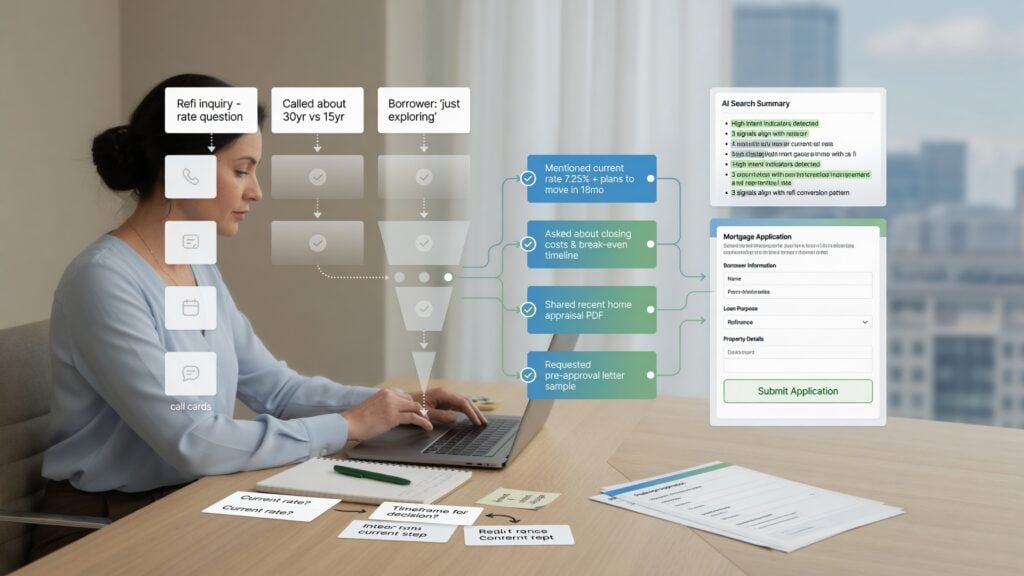
Many refinance conversations stall before the application because the borrower is interested, but not ready.
A homeowner may want to know whether refinancing could lower a payment, access cash, shorten a loan term, consolidate debt, or create more financial flexibility. That curiosity matters, but it does not always mean the borrower is ready to complete an application.
For mortgage professionals, this distinction is important.
A refinance conversation can feel promising on the surface. The borrower asks questions. They mention rates. They may fill out a form, answer a call, or request information. But after the first exchange, the conversation slows down, follow-up goes unanswered, or the borrower says they are still thinking.
That does not always mean the loan officer did something wrong.
Often, the borrower was still in the research stage.
The practical question is not only, “How do we get more refinance conversations?”
It is also, “How do we recognize whether a borrower has general interest or genuine application intent?”
This article is Part 4 of Evoltra’s Refinance Demand Series: Why Refinance Leads Are Drying Up, The End of Bought Mortgage Leads, Why Refinance Conversations Do Not Convert Like They Used To, this article, and High-Intent Refinance Conversations Before the First Call.
The Core Answer: Why Do Refinance Conversations Stall?
Refinance conversations often stall because borrower interest is mistaken for borrower intent. Interest means the homeowner is curious about rates, payments, cash-out options, equity, or timing. Intent means the borrower is actively evaluating whether refinancing makes sense, comparing options, understanding tradeoffs, and moving toward a decision. Applications usually happen when curiosity becomes clarity, confidence, timing, and trust.
That distinction affects the entire conversation.
A borrower who asks, “What are rates today?” may not be ready to apply.
A borrower who asks, “What would my break-even point look like if I refinance and pay closing costs?” may be further along.
A borrower who clicks an ad may be curious.
A borrower who compares Loan Estimates from multiple lenders may be closer to a decision. The Consumer Financial Protection Bureau explains that a Loan Estimate shows important details about a mortgage loan and encourages borrowers to request multiple Loan Estimates so they can compare offers and choose the loan that is right for them.
The difference is readiness.
Mortgage professionals do not need to pressure borrowers through that gap. They need to recognize it clearly.
Key Takeaways
- Refinance interest and refinance intent are not the same.
- A borrower can be curious about refinancing without being ready to complete an application.
- Early interest often shows up as rate checking, general questions, headline reactions, or vague curiosity.
- Stronger intent often shows up as specific goals, timeline, comparison behavior, cost awareness, and decision criteria.
- Many stalled refinance conversations are readiness problems, not simply sales or follow-up problems.
- Borrowers may pause because they are comparing lenders, reviewing costs, waiting for timing, or deciding whether the benefit is strong enough.
- Clear website content, refinance FAQs, service pages, and inquiry paths can help borrowers self-orient before speaking with a mortgage professional.
- AI-assisted search can shape what borrowers understand before contact, but no content or visibility strategy can guarantee applications, funded loans, rankings, or AI citations.
- The goal is not to pressure borrowers. The goal is to understand where they are in the decision process.
Why Refinance Curiosity Feels Like Intent
Refinance curiosity can look like intent because the borrower is taking action.
They may:
- search refinance rates,
- click a mortgage ad,
- submit a rate request,
- call after seeing a headline,
- ask about cash-out options,
- compare monthly payments,
- respond to an email,
- ask whether now is a good time,
- revisit a past lender or loan officer.
Those actions are meaningful, but they do not all signal readiness.
A homeowner may be exploring, not deciding.
They may want reassurance, not an application. They may be collecting information for later. They may be testing whether the numbers are even worth discussing.
This is why refinance conversations can feel busy but still produce fewer applications than expected.
The activity is real.
The intent may still be early.
Interest vs Intent: The Practical Difference
Interest is broad.
Intent is specific.
Interest usually sounds like:
- “I’m just checking rates.”
- “I wanted to see if refinancing makes sense.”
- “I’m curious about cash-out.”
- “I heard rates might change.”
- “I’m not sure yet.”
- “I just want to know what my payment could be.”
- “I’m not ready to do anything. I’m only looking.”
Intent usually sounds more focused:
- “I want to compare a cash-out refinance against a home equity line of credit.”
- “I need to understand my break-even point.”
- “I want to reduce my payment if the numbers make sense.”
- “I am considering debt consolidation and want to understand the refinance option.”
- “I am comparing offers from a few lenders.”
- “I want to know what closing costs would mean in my situation.”
- “I plan to make a decision within a specific timeframe.”
The difference is not just the wording.
It is the borrower’s decision stage.
A curious borrower is trying to understand whether refinancing deserves attention.
An intent-driven borrower is trying to decide whether refinancing is the right move.
The Four Common Stages of Refinance Readiness
Not every refinance conversation belongs in the same category.
Mortgage professionals can often understand the conversation more clearly by recognizing four common stages of readiness.
| Borrower Stage | What It Often Sounds Like | What It Usually Means |
| Early interest | “I’m just checking rates.” | The borrower is curious but not committed to a decision. |
| Information gathering | “How does refinancing work right now?” | The borrower wants education before evaluating options. |
| Comparison behavior | “I’m looking at a few lenders.” | The borrower is weighing numbers, trust, timing, and fit. |
| Stronger application intent | “I want to know if this makes sense and what I need to do next.” | The borrower is closer to action if the numbers and trust are there. |
These stages are not perfect labels.
Borrowers can move forward, pause, or step back.
But the stages help mortgage professionals avoid treating every conversation as application-ready.
That matters because a borrower in the early-interest stage may need clarity, not pressure.
A borrower showing stronger intent may need a clear next step, not more generic education.
Why Borrowers Stall After the First Conversation
Borrowers often stall because refinancing is not a simple yes-or-no decision.
A refinance can affect:
- monthly payment,
- interest paid over time,
- loan term,
- cash flow,
- equity,
- closing costs,
- debt strategy,
- timing,
- future plans,
- risk tolerance,
- comparison with other financial options.
After a conversation, the borrower may need time to process the tradeoffs.
A stalled refinance conversation may mean:
- the borrower does not understand the benefit clearly,
- the savings are not strong enough,
- closing costs feel unclear,
- the timing is not urgent,
- the borrower is comparing other lenders,
- the borrower is comparing refinancing with another option,
- the borrower needs more trust before sharing information,
- the borrower has not discussed the decision with a spouse or partner,
- the borrower was never application-ready.
The pause is not always rejection.
Sometimes it is unfinished thinking.
The problem comes when a mortgage team treats unfinished thinking as if it were a sales objection. In many cases, it is a readiness signal.
What Early Refinance Interest Looks Like
Early refinance interest is usually broad, vague, and reactive.
It often begins with a headline, a conversation with a friend, a rate update, a change in household finances, or a general sense that refinancing might be worth checking.
Common early-interest signals include:
- the borrower asks mostly about rates,
- the borrower does not know their current loan details,
- the borrower has no clear timeline,
- the borrower is unsure why they want to refinance,
- the borrower asks for a quick estimate without wanting context,
- the borrower says they are “just looking,”
- the borrower has not considered closing costs,
- the borrower has not compared refinance options,
- the borrower is not ready to provide documentation.
This stage is not bad.
A borrower who is curious today may become serious later.
But early interest should be understood for what it is: the beginning of the decision process, not the end.
What Information Gathering Looks Like
Information gathering is a step beyond casual curiosity.
The borrower may not be ready to apply, but they are trying to understand the decision more seriously.
They may ask:
- “How do closing costs work?”
- “How do I know whether refinancing is worth it?”
- “What is a break-even point?”
- “How much equity do I need?”
- “What is the difference between a cash-out refinance and a home equity line of credit?”
- “Would refinancing restart my loan term?”
- “What documents are usually involved?”
- “How does a refinance affect monthly payment?”
These questions show the borrower is trying to orient themselves.
A borrower in this stage may benefit from clear educational content before or after speaking with a mortgage professional.
That may include refinance FAQs, service pages, comparison articles, plain-language explanations, and contact paths that help them understand what kind of conversation to start.
This is where website clarity matters.
The website should not force every borrower into a form before they understand the basics.
What Comparison Behavior Looks Like
Comparison behavior is often a stronger signal than general curiosity.
Borrowers compare because refinancing can involve real financial tradeoffs.
They may compare:
- lenders,
- loan estimates,
- rates,
- closing costs,
- monthly payments,
- loan terms,
- refinance versus home equity options,
- fixed versus adjustable possibilities,
- cash-out versus rate-and-term refinance,
- whether to refinance now or wait.
The CFPB’s mortgage shopping guidance tells borrowers to compare Loan Estimates from multiple lenders, and its Loan Estimate explainer says the form helps borrowers understand important mortgage loan details.
That comparison behavior can be frustrating for lenders, but it is normal borrower behavior.
A borrower who compares is not automatically disloyal or unserious.
They may be doing exactly what an informed borrower is expected to do.
For mortgage professionals, the goal is to help the borrower understand the decision clearly while maintaining trust and appropriate boundaries.
What Stronger Application Intent Looks Like
Stronger application intent usually includes more specificity.
The borrower may have:
- a clear refinance goal,
- a defined financial reason,
- a realistic timeline,
- current loan details,
- questions about costs,
- awareness of tradeoffs,
- a reason to compare now,
- willingness to share information,
- interest in the next step,
- confidence in the mortgage professional.
For example, a borrower who says, “I want to know whether a cash-out refinance could help me consolidate debt, and I’m comparing that with a home equity line,” is not asking the same question as someone who says, “What are rates?”
The first borrower is evaluating a decision.
The second borrower may only be scanning the market.
Stronger intent does not guarantee an application.
But it usually gives the conversation more structure.
Why More Refinance Leads Do Not Always Mean More Applications
More refinance leads can create more activity without creating more application-ready borrowers.
A lender or mortgage broker may receive more calls, form fills, or rate requests, but still see weak movement into applications if many borrowers are too early in the decision process.
More low-intent volume can create:
- more calls with borrowers who are “just checking,”
- more follow-up that goes unanswered,
- more rate-only conversations,
- more confusion around closing costs,
- more borrowers comparing without clear criteria,
- more time spent educating people who are not ready,
- more strain on loan officers,
- less attention for stronger-intent borrowers.
This is why lead volume and lead quality are different.
The issue is not whether the borrower has any interest.
The issue is whether the borrower has enough clarity, trust, and timing to move toward an application.
How Private Research Shapes Refinance Intent
Many borrowers begin forming intent before they contact a mortgage professional.
They search, compare, calculate, read, ask questions, and discuss options privately.
That research may happen through:
- Google searches,
- AI-assisted search experiences,
- mortgage calculators,
- lender websites,
- comparison content,
- refinance FAQs,
- review platforms,
- Google Business Profiles,
- conversations with friends or family,
- financial articles,
- email updates from past lenders.
Google says AI Overviews and AI Mode are part of Google Search from a site owner perspective, and that SEO best practices remain relevant for AI features in Search.
For mortgage professionals, the practical point is not that AI search controls borrower decisions.
It does not.
The point is that some borrower education now happens before the lender sees the inquiry.
A borrower may arrive with expectations already shaped by search results, AI-assisted answers, calculators, reviews, and competing lender content.
If that early research is confusing, incomplete, or disconnected from the lender’s website, the first conversation may start with more uncertainty.
Why Website Clarity Helps Borrowers Self-Orient
A clearer website can help borrowers understand where they are in the refinance decision.
It can help them distinguish between:
- general rate curiosity,
- a cash-flow question,
- a debt consolidation question,
- a cash-out question,
- a break-even question,
- a loan-term question,
- a timing question,
- a comparison question,
- a ready-to-apply conversation.
A refinance page does not need to answer every question or replace a professional conversation.
It should help borrowers understand the type of decision they are considering.
Helpful website elements may include:
- a clear refinance service page,
- plain-language explanations,
- refinance FAQs,
- articles that explain common decision points,
- content about comparison factors,
- a visible contact path,
- a simple way to ask a question,
- clear statements about what happens next,
- reviews or trust signals where appropriate,
- links to relevant mortgage service pages.
This is not about pushing borrowers faster than they are ready.
It is about reducing confusion before the conversation. On the website side, making refinance content answer-ready is the focus of Evoltra’s AEO Website Optimization service.
Evoltra’s article on why service pages matter for professional firms explains how clear service pages can help prospects understand what a firm does and whether it fits their need.
For mortgage professionals, service clarity is especially important because borrowers often do not know how to frame the refinance question.
How Inquiry Paths Can Support Better Refinance Conversations
The path from research to contact should help the borrower choose the right kind of next step.
A borrower who is not ready to apply may still want a question answered.
A borrower who is comparing scenarios may need a more structured conversation.
A borrower who is ready to move forward may need a clear application path.
Inquiry paths can support better conversations when they make the next step clear without creating pressure.
Examples include:
- a contact option for refinance questions,
- a refinance-focused inquiry form,
- a website chatbot that answers basic navigation questions,
- a phone path for borrowers ready to speak with someone,
- a scheduling path where appropriate,
- a follow-up process that respects borrower readiness.
This is not about manipulation.
It is about fit.
A borrower who only wants general education should not be treated the same as a borrower who is asking how to move forward.
Evoltra’s article on what a website chatbot actually does for a professional firm explains how a chatbot can support basic routing and inquiry capture without replacing professional judgment. For the fuller picture of phone, form, and follow-up together, see AI intake systems for professional firms.
Why Reviews and Trust Signals Still Matter
A refinance conversation can stall when the borrower does not yet trust the lender enough to share information or take the next step.
That trust may be shaped by:
- Google reviews,
- borrower comments,
- response patterns,
- loan officer bios,
- business profile accuracy,
- website clarity,
- professional tone,
- referral context,
- local visibility,
- consistency across profiles.
Reviews do not guarantee applications.
But they can help a borrower feel less uncertain before contacting or continuing a conversation.
Trust signals are especially important in refinance decisions because the borrower is often being asked to revisit a major financial commitment.
If the website explains the refinance service clearly, the reviews support credibility, and the contact path feels professional, the borrower may have an easier time continuing the conversation.
For firms that want a more consistent and ethical approach to reviews, Evoltra’s article on Building a Review Flywheel explains how professional firms can ask for feedback at natural moments without awkwardness, incentives, or review gating.
How to Think About Follow-Up Without Pressuring Borrowers
Follow-up matters, but not every stalled refinance conversation should be treated as a closing problem.
Some borrowers need time.
Some need clarity.
Some are comparing.
Some are not ready.
Some will not move forward because refinancing does not make sense for them.
A trust-based follow-up approach should respect the borrower’s decision stage.
That means the mortgage professional should think in terms of:
- clarity,
- timing,
- usefulness,
- next-step fit,
- borrower readiness,
- professional boundaries.
The goal is not to push a borrower into an application.
The goal is to help the borrower understand whether an application is the appropriate next step.
That distinction protects trust.
It also helps mortgage teams avoid wasting energy treating every early-stage inquiry as if it were ready to close.
Respecting readiness also means closing the gap between interest and response, so a borrower who reaches out while still comparing lenders is not left without a clear next step.
What Mortgage Professionals Should Review at a High Level
This is not a full conversion audit or sales process manual.
But mortgage professionals can review whether their refinance visibility and inquiry experience support the move from interest to intent.
At a high level, review whether borrowers can easily understand:
| Area | What to Notice |
| Refinance service page | Does it explain the service clearly? |
| Refinance FAQs | Do they answer real borrower questions? |
| Educational content | Does it clarify decisions like break-even, cash-out, costs, and timing? |
| Inquiry path | Can borrowers choose an appropriate next step? |
| Reviews and trust signals | Do they support confidence before contact? |
| Google Business Profile | Is business information accurate and current? |
| AI search visibility | Could borrowers encounter clear information during early research? |
| Internal links | Do refinance articles, service pages, and contact paths connect naturally? |
| Follow-up process | Does it distinguish early curiosity from stronger intent? |
| Application path | Is the next step clear for borrowers who are ready? |
The purpose is not to pressure more people into applying.
The purpose is to understand where conversations are stalling and whether borrowers have enough clarity before and after contact.
A Simple Way to Classify Refinance Conversations
Mortgage professionals can think about refinance conversations in four broad categories.
| Conversation Type | Borrower Mindset | Best Strategic Response |
| Curious | “I wonder if refinancing is worth checking.” | Provide orientation and avoid overreading the signal. |
| Researching | “I need to understand how this works.” | Offer clear education and help frame the decision. |
| Comparing | “I am weighing lenders, costs, and options.” | Support clarity, trust, and transparent next steps. |
| Intent-driven | “I am deciding whether to apply.” | Make the application path clear and appropriate. |
This is a strategic lens, not a script.
It helps loan officers and mortgage teams avoid treating every refinance conversation the same way.
How Evoltra Helps Mortgage Professionals Strengthen Borrower Readiness
Evoltra Solutions helps mortgage professionals become easier to find, understand, trust, and choose across Google, AI search, reviews, website clarity, business profiles, service pages, and inquiry capture.
For refinance-focused visibility, Evoltra looks at how borrowers may encounter a mortgage professional before the first conversation and whether the online presence helps them understand the refinance decision clearly.
That may include:
- refinance service-page clarity,
- borrower education content,
- Google visibility,
- AI-assisted search visibility,
- review trust signals,
- Google Business Profile accuracy,
- profile consistency,
- inquiry capture,
- clear next steps.
Evoltra does not promise rankings, AI citations, lead volume, refinance applications, funded loans, or immediate results.
The focus is clarity, trust, and better visibility foundations, tracked over time rather than checked once, as Evoltra’s article on AI visibility tracking explains.
An Authority Score assessment can help identify whether a mortgage professional’s public presence supports borrower confidence or creates friction before the application stage.
The Mortgage Professionals industry page explains how Evoltra supports mortgage brokers, loan officers, and lending teams with visibility systems built around trust, clarity, and discoverability.
Final Thoughts: Better Refinance Applications Begin With Better Intent
Most refinance conversations do not stall because borrowers are impossible to reach.
Many stall because the borrower was interested, but not ready.
They may still be researching.
They may still be comparing.
They may still be unsure about timing.
They may still need to understand costs, benefits, and tradeoffs.
They may still be deciding whether refinancing makes sense at all.
For mortgage professionals, the opportunity is not to pressure every conversation toward an application.
The opportunity is to recognize readiness more clearly.
Interest asks, “Could this be worth looking into?”
Intent asks, “Does this make sense for me, and what should I do next?”
When a mortgage professional understands that difference, refinance conversations become easier to evaluate.
Clear website content, helpful FAQs, service pages, reviews, inquiry paths, and follow-up systems can all support that journey.
They cannot guarantee applications or funded loans.
But they can help borrowers move from confusion to clarity, and from general interest to a more informed next step.
Previous in the series: Why Refinance Conversations Do Not Convert Like They Used To
Next in the series: High-Intent Refinance Conversations Before the First Call
Frequently Asked Questions
Why do refinance conversations stall before the application?
Refinance conversations often stall because the borrower is interested but not ready. They may be checking rates, comparing options, reviewing costs, waiting for better timing, or deciding whether refinancing makes sense before completing an application.
What is the difference between refinance interest and refinance intent?
Refinance interest means a homeowner is curious about refinancing. Refinance intent means the homeowner is actively evaluating the decision, comparing options, understanding tradeoffs, and moving closer to applying.
What are signs of early refinance interest?
Early refinance interest may sound like rate checking, vague curiosity, headline reactions, or questions such as “Does refinancing make sense?” without a clear goal, timeline, or willingness to discuss details.
What are signs of stronger refinance intent?
Stronger refinance intent often includes a specific goal, timeline, comparison behavior, questions about closing costs or break-even point, willingness to share information, and interest in the next step.
Why do borrowers compare lenders before applying?
Borrowers compare lenders because mortgage decisions involve rates, costs, terms, payments, service, trust, and long-term financial impact. The CFPB encourages borrowers to request multiple Loan Estimates so they can compare offers.
Can better website content create more refinance applications?
Better website content can help borrowers understand refinancing more clearly and may support better conversations. It cannot guarantee refinance applications, funded loans, rankings, leads, or business outcomes.
How can mortgage professionals avoid pressuring early-stage borrowers?
Mortgage professionals can avoid pressure by recognizing the borrower’s stage, answering questions clearly, explaining appropriate next steps, and not treating every early inquiry as application-ready.
How does AI search affect refinance conversations?
AI-assisted search can shape what borrowers understand before they contact a mortgage professional. Borrowers may use AI search to compare options, understand terms, and prepare questions before speaking with a lender. Google says AI Overviews and AI Mode are part of Google Search, and SEO best practices remain relevant for those features.