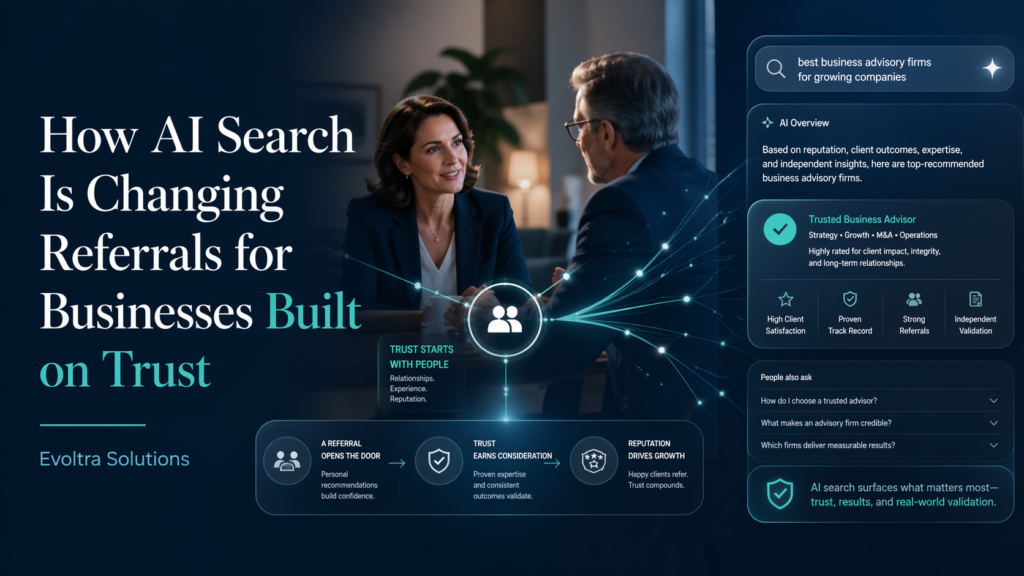
Referrals still matter.
For many professional firms, they remain one of the strongest ways a new prospect first hears the firm’s name. A friend recommends an attorney. A business owner mentions a CPA. A colleague suggests a financial advisor. A realtor or past client names a mortgage professional. A business contact recommends an insurance agency.
But what happens after that recommendation is changing.
A prospect may not move straight from referral to phone call. They may ask Google, ChatGPT, Perplexity, Gemini, or another AI-powered search experience for more context. They may ask what to look for, how to compare firms, what questions to ask, or whether the referred firm appears to match their need.
That means AI search is not replacing referrals.
It is adding a new layer between the recommendation and the inquiry.
For trust-based professional firms, that layer matters because the referral journey is no longer only human-to-human. It is increasingly human recommendation plus digital validation plus AI-assisted interpretation.
The Core Answer: How Is AI Search Changing Referrals?
AI search is changing referrals by adding an interpretation layer between the recommendation and the decision to contact. A prospect may still receive a name from someone they trust, but before calling, they may use AI-powered search to understand what the firm does, compare options, prepare questions, read summaries, or evaluate whether the firm’s public information supports the recommendation.
That does not mean AI search controls the referral.
It means AI can influence how the referral is understood.
For a professional firm, the practical question becomes:
When AI-powered tools and search experiences interpret your public presence, do they find clear, consistent, and credible information?
Google states that AI Overviews and AI Mode are part of Google Search, and that SEO best practices remain relevant for these AI features. Google also says its generative AI features in Search are rooted in core Search ranking and quality systems.
That matters because AI-assisted search still depends on public information.
A firm cannot force an AI system to recommend it. It cannot guarantee citations, summaries, rankings, leads, or clients.
But it can reduce confusion by making its services, expertise, reviews, profiles, and trust signals easier to understand.
Key Takeaways
- AI search is not replacing referrals. It is changing what happens after a referral is received.
- A prospect may use AI search to interpret the referral, compare options, prepare questions, or understand what matters before contacting a firm.
- This article focuses on the AI-search layer of the referral journey, not referrals in general.
- Clear service pages, consistent profiles, useful content, reviews, and professional bios can help reduce confusion.
- Google says AI Overviews and AI Mode are part of Google Search, and that SEO best practices remain relevant for AI features.
- No firm can guarantee AI recommendations, AI citations, rankings, leads, or clients.
- The practical goal is to make the firm easier for people and AI-assisted systems to understand and verify.
What AI Search Adds to the Referral Journey
The traditional referral journey used to feel fairly simple.
Someone recommended a firm.
The prospect searched the firm name or visited the website.
The prospect called if the recommendation felt strong enough.
That path still happens.
But now, another step may appear in the middle.
A referred prospect may ask an AI-powered tool questions like:
- “What should I look for in an estate planning attorney?”
- “How do I compare CPAs for a small business?”
- “What questions should I ask a financial advisor before meeting?”
- “How do I compare mortgage professionals?”
- “What should I know before choosing a business insurance agency?”
- “What does this type of professional usually help with?”
- “What should I check before contacting this firm?”
These questions may not be about your firm name at first.
They may be about the category, the decision, the risks, or the comparison process.
That is the AI-search layer.
The prospect is using AI to interpret the decision before contacting anyone.
For professional firms, this creates a new responsibility. Your public information should help AI-assisted tools and real people understand what you do, who you help, where you serve, and why your expertise is credible.
AI Search Does Not Replace the Human Referral
A personal recommendation still carries weight.
If someone trusted says, “Call this firm,” that matters. It creates initial confidence that no search result can fully duplicate.
But today, a human referral often gets checked against digital signals.
That check may include Google results, reviews, business profiles, service pages, professional bios, directory listings, articles, and AI-generated summaries.
This article focuses on the AI layer of that process.
For the broader referral strategy, read Evoltra’s article on why referrals still need a strong online presence.
For the more practical “what does a referred prospect actually see?” angle, read what referrals see when they Google you.
Together, those articles explain the referral journey from different angles. This one focuses on how AI-powered search can shape the interpretation step.
What a Referred Prospect May Ask AI Before Contacting You
A prospect may not ask AI, “Should I hire this exact firm?”
More often, they ask broader questions to understand the situation.
For example, an estate planning prospect may ask what documents matter before meeting an attorney. A business owner may ask whether a CPA or bookkeeper is the right fit. A family may ask what to ask a financial advisor. A borrower may ask what to compare before refinancing. A business owner may ask what coverage questions to discuss with an insurance agency.
AI search can influence the referral journey by helping the prospect:
- define the problem,
- understand the service category,
- compare different provider types,
- prepare questions,
- identify warning signs,
- clarify terminology,
- understand what credentials or experience may matter,
- decide whether the referred firm appears relevant.
This is not the same as replacing professional advice.
AI-generated answers can be incomplete or imperfect, and a prospect still needs qualified guidance for legal, tax, financial, mortgage, or insurance decisions.
But AI can shape what the prospect expects before reaching out.
That is why professional firms need content that answers real questions clearly, not just marketing copy that sounds polished.
The New Referral Path: Recommendation, Research, Interpretation, Contact
AI search adds a middle layer to the referral journey.
A simple way to think about it is:
| Stage | What Happens | What the Prospect Needs |
| Recommendation | Someone gives the firm’s name | Initial trust |
| Research | The prospect searches online | Public confirmation |
| AI interpretation | The prospect asks questions or reads summaries | Context and comparison |
| Validation | Reviews, profiles, bios, and service pages are checked | Credibility and fit |
| Contact | The prospect calls, chats, or submits a form | A clear next step |
The referral starts the process, but it may not finish it.
A prospect may still want independent confirmation. AI-powered search can become part of how they create that confirmation.
For firms built on trust, the strongest position is not to resist this behavior.
It is to be clear enough to survive it.
What AI Search Needs to Understand About a Professional Firm
AI-powered search experiences depend on available information. They may interpret content from websites, search results, business profiles, reviews, directories, and other public sources.
A professional firm becomes easier to interpret when public information answers basic questions clearly.
What the Firm Does
A firm should not rely on broad phrases like “comprehensive solutions” or “trusted guidance” without explaining the actual services.
An attorney should make practice areas clear. A CPA should distinguish tax, accounting, bookkeeping, and advisory services. A financial advisor should explain planning focus. A mortgage professional should clarify purchase, refinance, and borrower scenarios. An insurance agency should explain coverage categories and service focus.
Clear service pages help both prospects and AI-assisted systems understand relevance.
Who the Firm Helps
A professional firm should make its audience understandable.
That may include individuals, families, business owners, retirees, borrowers, policyholders, employers, or specific client situations.
The point is not to exclude everyone else.
The point is to reduce ambiguity.
AI search works better with clear relationships between services, audiences, locations, and expertise.
Why the Firm Is Credible
Credibility may come from several public signals:
- professional bios,
- reviews,
- service-specific content,
- business profiles,
- directory listings,
- local relevance,
- credentials where appropriate,
- consistent descriptions,
- educational articles,
- third-party references.
No single signal does all the work.
The full public picture matters, which is why AI search needs more than a website to understand a firm.
How Someone Can Take the Next Step
AI-assisted research may lead the prospect back to the website, Google Business Profile, contact page, chat, form, or phone number.
If the next step is unclear, the referral can lose momentum.
The firm should make contact paths easy to understand without pressuring the prospect.
Why Generic Marketing Language Weakens AI-Assisted Referrals
Generic language creates a problem in AI search because it gives systems and prospects less specific information to interpret.
Many professional firm websites say things like:
- “We put clients first.”
- “We provide personalized service.”
- “We offer trusted guidance.”
- “We help you navigate complex decisions.”
- “We deliver professional solutions.”
These statements may be true.
But they do not explain enough.
They do not clarify:
- which services the firm provides,
- who the firm helps,
- what situations the firm supports,
- what makes the expertise relevant,
- what location or market the firm serves,
- what questions the firm is qualified to answer.
A referred prospect may already have a name.
AI-assisted research helps them decide whether that name fits the problem.
If the public language is too broad, the firm becomes harder to evaluate.
This is why answer-ready content matters. Evoltra’s article on the three pillars of answer engine optimization explains how structured clarity, topical authority, and conversational alignment help professional firms create content that is easier to understand.
What Digital Reinforcement Looks Like in AI Search
Referrals now depend on reinforcement, not reputation alone.
Digital reinforcement means the public information around the firm supports the trust created by the referral.
That reinforcement may come from:
- clear service pages,
- consistent Google Business Profile information,
- professional bios,
- current reviews,
- ethical review patterns,
- directory consistency,
- useful educational content,
- business descriptions that match across platforms,
- local relevance,
- clear contact paths.
AI search can bring these signals into the prospect’s research process.
For example, a prospect may receive a referral to a financial advisor, then use AI search to ask what questions to ask before a consultation. If the firm’s website clearly explains planning focus, client fit, and next steps, the referral feels easier to validate.
A borrower may hear a mortgage professional’s name, then ask AI what to compare before refinancing. If the professional’s public content explains refinance scenarios clearly, the prospect has more context.
A business owner may receive an insurance agency referral, then ask AI what coverage questions to prepare. If the agency’s service pages and educational content are clear, the firm becomes easier to understand.
This is the practical role of AI search in referrals.
It helps prospects interpret what they are seeing.
Why Some Strong Firms Still Get Overlooked in AI-Assisted Research
A firm can be excellent in real life and still be unclear online.
That is one of the most important points for trust-based businesses.
The problem is not always quality. Often, it is translation.
The firm’s real expertise has not been translated into public signals that people and AI-assisted systems can understand.
Common issues include:
- vague service pages,
- outdated bios,
- inconsistent business profiles,
- weak or old service descriptions,
- limited educational content,
- reviews that do not reflect current services,
- directory listings that tell different stories,
- unclear location or service area information,
- content written for keywords instead of questions,
- no clear connection between services, expertise, and next steps.
These gaps do not mean the firm is bad.
They mean the firm may be harder to interpret than it should be.
A referral can create initial trust, but unclear online information can weaken that trust before the first conversation.
How This Applies Across Evoltra’s Core Industries
Attorneys
For attorneys, AI-assisted referral research may include questions about practice areas, documents, process, timing, and what to ask before a consultation.
A law firm should make its focus clear without giving legal advice online. Evoltra’s article on why some law firms are easier for AI search to trust looks at this in more detail.
For example, an estate planning, probate, or elder law firm should help prospects understand the difference between services, who each service may be for, and when to speak with an attorney.
CPAs and Tax Professionals
For CPAs and tax professionals, prospects may use AI search to understand whether they need tax preparation, tax planning, bookkeeping, accounting, or advisory support.
Clear service distinctions matter because many prospects do not know the terminology.
The firm’s public presence should help them understand which conversation to start.
Financial Advisors
For financial advisors, AI-assisted research may include questions about planning focus, credentials, fees, retirement preparation, business owner planning, or what to ask during an initial conversation.
The firm should make its services and audience fit understandable without giving personalized financial advice online.
Mortgage Professionals
For mortgage professionals, prospects may use AI search to compare refinance options, purchase loan questions, borrower scenarios, local guidance, or what documents may be discussed.
The firm should make its service focus and next steps clear without promising approval, rates, or outcomes.
Insurance Agencies
For insurance agencies, prospects may ask AI about coverage categories, risk questions, policy reviews, business insurance, personal insurance, or what to ask an agent.
The agency should help prospects understand the type of guidance available without making coverage recommendations online.
Related Reading on Referrals
This article covers one step in the referral journey: what may happen after a referral but before contact, when AI search is involved. Evoltra’s other articles cover the steps around it:
- Why referrals still need a strong online presence explains why referrals need online validation at all.
- What referrals see when they Google you is a practical self-review from the referral’s point of view.
- Why people Google you before they call looks at pre-contact research in general, including non-referral paths.
- What prospects see when they search your firm by name covers the branded-search picture around the firm or professional.
Read together, they describe the full path from recommendation to first conversation.
What Professional Firms Should Focus On
Professional firms do not need to chase every AI trend.
They need to make their public presence easier to understand.
At a high level, that means focusing on:
Clear Services
The firm’s website should explain what services it provides in language prospects understand.
Specific Expertise
Professional bios, service pages, and educational content should help clarify what the firm is qualified to discuss.
Consistent Public Information
Business profiles, directories, website content, and service descriptions should support the same story.
Trust Signals
Reviews, professional experience, local relevance, and third-party references can help reinforce credibility.
Answer-Ready Content
Content should answer the questions real prospects ask before they contact a firm. On the website, that is the focus of AEO Website Optimization.
Clear Contact Paths
Once a prospect feels ready, the next step should be easy to find.
This is not a DIY checklist or an implementation roadmap.
It is the high-level foundation that makes AI-assisted referral validation more reliable.
What AI Search Cannot Do for a Firm
AI search can help prospects interpret information, but it cannot create trust where public signals are weak.
It also cannot guarantee that a firm will be cited, summarized, recommended, or chosen.
Professional firms should be cautious of any promise that suggests otherwise.
Google’s guidance says SEO best practices remain relevant for AI features in Search, but it does not say any business can force inclusion or citation.
For Evoltra, the safer and more honest goal is clarity.
Make the firm easier to understand.
Make the services easier to identify.
Make the trust signals easier to verify.
Make the next step easier to take.
The systems decide what they surface.
The firm controls how clearly it presents itself.
A Practical Next Step
If your firm depends on referrals, reputation, and trust, ask one AI-specific question:
When someone uses AI search to interpret our firm, does our public presence give those systems enough clear, consistent, credible information to work with?
That question is different from, “Do people know us?”
It is also different from, “Do referrals still happen?”
The question is whether AI-assisted research reinforces the trust people already have in you.
Evoltra helps professional firms evaluate that public trust layer across Google, AI search, reviews, website clarity, business profiles, service pages, and authority signals.
An Authority Score assessment can help identify where your firm is easy to understand, where the public picture is inconsistent, and where AI-assisted referral validation may be weakened by gaps.
For ongoing measurement, Evoltra’s article on AI visibility tracking over time explains why professional firms should watch patterns rather than treat AI visibility as a one-time ranking check.
Final Thoughts: AI Search Is the New Interpretation Layer After a Referral
The referral still matters.
A trusted person saying your name can still open the door.
But increasingly, the prospect may use AI-powered search to understand what to do with that recommendation.
They may ask what to look for.
They may compare options.
They may read summaries.
They may prepare questions.
They may check whether your public presence supports the referral.
That is the shift.
AI search is not replacing trust. It is becoming part of how trust is confirmed.
For attorneys, CPAs and tax professionals, financial advisors, mortgage professionals, and insurance agencies, the opportunity is not to chase AI shortcuts.
The opportunity is to become easier to understand and verify before the first conversation.
A referral may start the journey.
AI-assisted research may shape whether that journey continues.
Frequently Asked Questions
What are AI search referrals?
AI search referrals happen when a prospect receives or discovers a recommendation, then uses AI-powered search to understand, validate, compare, or gain confidence before contacting a professional firm.
Is AI search replacing referrals?
No. AI search is not replacing referrals. It is changing what happens after a referral by adding a layer of research, interpretation, and validation before the prospect makes contact.
Why does AI search matter for referral-based professional firms?
AI search matters because referred prospects may use it to understand what to ask, how to compare providers, what services mean, and whether the referred firm appears relevant and credible.
Can AI search weaken a strong referral?
Yes. A strong referral can lose momentum if the prospect finds unclear services, inconsistent profiles, thin content, weak reviews, outdated bios, or confusing business information during AI-assisted research.
Can a firm guarantee AI recommendations or citations?
No. A firm cannot guarantee AI recommendations, citations, summaries, rankings, leads, or clients. The practical goal is to make the firm easier to understand, verify, and evaluate.
What should professional firms improve first?
Professional firms should focus on clear service pages, consistent business information, useful educational content, professional bios, review visibility, and a clear contact path. These signals help both people and AI-assisted systems understand the firm more accurately.
Is this only about Google?
No. Google is important, but AI-assisted referral research can also involve ChatGPT, Perplexity, Gemini, directories, reviews, business profiles, and other public sources that help prospects interpret a firm.
How is this different from regular referral marketing?
Regular referral marketing focuses on who recommends the firm. AI-search referral strategy focuses on what happens after the recommendation, when prospects use AI-powered tools and search experiences to validate, compare, and interpret the firm.